
Plan to avoid catastrophic Spirit Lake flood would lower lake 40 feet, cost nearly $300 million
U.S. Forest Service releases massive EIS that seeks to guard Cowlitz communities from catastrophic flooding while protecting ecology of volcanic blast zone

A new federal plan would lower Spirit Lake 40 feet, construct a second drainage tunnel and repair an existing one as a hedge against future catastrophic flooding.
The plan would cost hundreds of millions of dollars and would drastically change the appearance and ecology of the iconic lake, perhaps dividing it in two, which is the reason some researchers oppose lowering it.
The U.S. Forest Service Tuesday released a final environmental impact statement that outlines a plan to prevent the lake from rising and breaching the mass of volcanic debris that blocked its outlet during the eruption of Mount St. Helens 46 years ago.
“This is a significant milestone in our work to protect downstream communities, reduce future flood risk, and strengthen the long‑term resilience of the Mount St. Helens landscape,” Johanna Kovarik, supervisor of the Gifford Pinchot National Forest, said in a prepared statement.
Congress will have to approve money to pay for the projects outlined the plan.
If the lake were to rise and breach the blockage, scientists say the ensuing flood would cause catastrophic damage along the Toutle, Cowlitz and Columbia rivers. (See more on this, below.)
Under the plan, the Forest Service would repair the existing 8,500-foot-long, 11-foot wide drainage tunnel the US. Army Corps of Engineers cut through Harry’s Ridge. It allows the lake to drain into South Coldwater Creek and eventually into the north fork of the Toutle River.
However, the tunnel cuts through a 300-foot-wide fault and has needed repairs since opening in 1985.
“The tunnel has shown signs of age‑related deterioration, including rock heaving and structural cracking, increasing maintenance needs and long‑term risk. While still functional, it requires rehabilitation to continue serving its role effectively into the future,” according to the Forest Service.
The plan also includes construction of a new “pressurized” tunnel near the existing conduit to serve as the lake’s new primary outlet. The old tunnel would be the backup.
A pressured underground conduit is completely filled with water to allow pressure — as opposed to gravity— to push water through.
Under the plan, the Forest Service would lower the lake from it current elevation — 3,440 feet — down to 3,400 feet — to increase safe water storage capacity in case a tunnel failure. The lake is considered safe as long as it does not rise above 3,460 feet, a level the lake has reached on three occasions.
The EIS also calls for building a permanent access route across the Pumice Plain on the south shore of Spirit Lake along the Truman Trail alignment and constructing a temporary haul route.
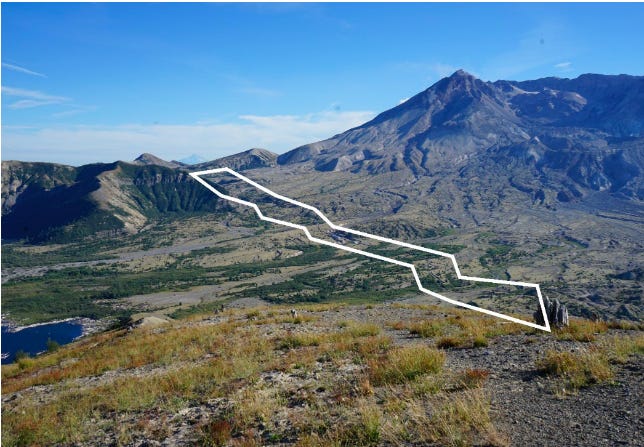
The Forest Service also says it will further study an idea to reconnect Spirit Lake directly into the North Fork Toutle River through a natural habitat channel.
Such a project would cost hundreds of millions of dollars and involve a risk of crossing unstable ground at the foot of a frequently-active volcano. However, it would raise the possibility of enabling salmon and steelhead to migrate naturally back to the lake.
The basic plan is little changed from a draft environmental impact statement the Forest Service released last year. The agency considered multiple options before settling on the one outlined in the final EIS.
The cost of the preferred plan is estimated roughly at $265 million — $53 million to rehab the existing tunnel and $215 million for the new pressure tunnel. This does not include the cost of creating a new natural channel across the debris blockage.
Spirit Lake is within the 110,000-acre Mount St. Helens National Volcanic Monument, which Congress created in 1982 to protect natural processes in part of the area blasted by Mount St. Helens on May 18, 1980. The legislation allows work to protect public safety, but the Forest Service has often found its management of the area caught in a pinch between ecological and human safety concerns.
It said it has tried to balance all the competing needs of research, recreation and flood control.
“The Spirit Lake Outflow Safety Improvement Project identifies a reliable long‑term solution for managing lake water levels while balancing ecological, cultural, and operational needs,” the agency said.
The Forest Service consulted a wide range of local officials, the Cowlitz Indian Tribe and other interest groups in developing the plan. The massive document is available here. The plan is subject to a 60-day public comment period.
Flood by the numbers
A catastrophic break of the Spirit Lake debris blockage could release 314,000 acre-feet of water (32 billion gallons, or the volume of 48,000 Olympic swimming pools ) and 2.4 billion cubic yards of sediment, or more than 10 times the volume of debris that washed into the Toutle and Cowlitz rivers during the volcano’s great eruption
Projected worst case mudflow heights are 60 feet at Castle Rock;
30 to 40 feet at Toutle, Silver Lake, Kelso, and Longview; and 15 to 20
feet at Toledo (The mudflow would back up the Cowlitz, as it did during the volcano’s eruption 46 years ago.)
If the drainage tunnel failed, it would take five to eight months for the lake to rise enough to pose an imminent breakout threat.
Source: Spirit Lake Outflow Safety Improvement Project
This column and all other Lower Columbia Currents stories and content are copyrighted and may not be copied or used in any other publication without the express consent of Andre Stepankowsky, the publisher. Readers who want to share the stories may do so by sharing links to them.
Please keep comments short and polite.
How many millions of dollars did it cost the Forest Service to come up with this "pipe dream"? The huge funding would be required by our federal government, which could not possibly care less about the possibility of catastrophic flooding in our area, and any concerns about ecology have been abolished under the current administration. Dream on.